How to source creators for influencer gifting: the four-lane pipeline behind 50,000 profiles
By Yagna, founder of Sift · July 16, 2026
Here is the entire system. Everything after this box is one line explained.
The pipeline
- Lane 1 — Organic scroll. 15 min/day. A curation account per platform, follow known-good creators per genre, log the ones the algorithm serves you as seeds. $0.
- Lane 2 — Lookalike snowball. 90 min, once a week. Harvest each platform's own "suggested accounts" off your seeds, two generations deep, then stop. $0.
- Lane 3 — Scrapers. Scheduled, zero human minutes. Scrape platform search results using the queries your customers type, not creator labels. Scraper credits, single-digit dollars per run.
- Lane 4 — Enterprise database dump. 30 min/week. Cheapest tier of a Modash-class tool, run your seeds through its lookalike search, export the CSV cap daily. One month at a time — it's a faucet, not a home.
- Every row lands in one master sheet: handle | platform | genre | source lane | date | status.
- Every lane produces 100+ profiles per run. Nothing here is a growth hack — it's runs, compounding.
- The output is dirty by design. Sourcing buys volume with plausible fit. Deciding who's real, alive, and worth a package is vetting — a separate job, downstream.
- Weekly cost: about two hours of hands-on time and less than the product cost of one gifted package.
We've put 50,000+ raw profiles into the master sheet this way. That number sounds like infrastructure. It isn't. A scraper run returns 100-some profiles. A database export returns 100-some more. An afternoon of lookalike-hopping returns a few hundred. Do that on a weekly rhythm and the sheet crosses 50,000 before you've built anything you'd call a system.
That's the honest shape of sourcing: it is not a discovery problem, it's an accumulation habit. The teams that struggle aren't failing to find creators — they're trying to make every found creator count, vetting each one on sight, sourcing carefully and slowly. Wrong order. A wide, cheap, dirty net beats a careful narrow search, because precision belongs to the next step, where it's 10× cheaper to apply.
The rest of this post walks each lane: what it's for, the exact protocol, what it costs, and where it breaks.
1. Define genres before you touch any tool
Every lane below runs on search — and search needs to know what it's looking for. The first real work of sourcing is a genre map, and the map is never your product category.
Ultrahuman makes a smart ring. The category answer is "fitness influencers." The map we actually ran was nine genres wide:
- health — general wellness, explicitly not bodybuilding
- recovery
- mindfulness
- wearables
- fashion (watches) — a ring is wrist-and-hand real estate; watch collectors already film it
- EDC — everyday carry; a ring is literally carried every day
- travel
- luxury goods
- productivity
The logic: genres come from who uses the product in the wild, not from what shelf it sits on. A smart ring is a recovery tool to a hybrid athlete, jewelry to a watch collector, a gadget to an EDC channel, and a focus tool to a productivity creator. Each of those audiences buys the same ring for a different reason — and no tool's category dropdown connects them, because "contexts where the product shows up" is not a category.
The exclusions matter as much as the inclusions. Bodybuilding sits under the same fitness umbrella and got cut: it's the same shelf but a different buyer. An audience watching for size and strength programming isn't the audience that buys a sleep-and-recovery wearable.
The exercise, for any product:
- List every context the product is used, worn, or seen in.
- For each context, name the creator genre that films it.
- For each genre, finish the sentence: "this audience buys because ___." Can't finish it → cut the genre.
- Cap at 8-12. If you're under 5, you're still thinking in product categories.
Each genre becomes its own sourcing lane from here: its own seeds, its own search language, its own hit rate.
2. Lane 1 — Organic scroll: seeds, not volume
Everyone already does this lane — badly. You scroll TikTok, spot a creator who'd be perfect, screenshot them, and lose the screenshot. The problem isn't the scrolling; it's that nobody treats it as a job with an output.
Reframed properly, this lane has exactly one job: producing seeds — reference profiles so obviously right that you'd ship them product today without a second look. Not volume. Ten to thirty seeds per genre. Every other lane in this pipeline either feeds on seeds (Lane 2 and Lane 4 run lookalike searches off them) or is calibrated by them (Lane 3 queries come from their video titles). Seed quality caps the quality of everything downstream, which is why this is the one lane you can't skip and can't delegate on day one.
The protocol:
- One curation account per platform. Not your personal account — you're about to train an algorithm, and your cousin's wedding photos are noise in the training data.
- Follow 10-20 known-good creators per genre. Your genre map from section 1 tells you where to start looking.
- Engage only with on-genre content. Every off-genre like poisons the feed. Discipline here is the whole technique — you are deliberately overfitting the recommendation algorithm to one genre.
- 15 minutes a day. When the feed serves you someone right: handle goes to the master sheet, genre tag, marked
SEED. If you hesitate on whether they're a seed — they're not. Log them as a regular candidate and move on.
Honest costs: slow, unscalable, and the algorithm takes a week or two to converge on each genre. Fine. You're not buying volume here; you're buying the fuel every other lane burns.
Run it today: create the curation account, pick your two strongest genres, follow 15 creators in each, set a daily 15-minute timer. First seeds inside a week.
3. Lane 2 — The lookalike snowball
Modash charges $199 a month and up for lookalike search, and it's one of the genuinely good features of these platforms. Here's the part nobody says out loud: every platform already ships a lookalike model, for free, in the UI. Instagram's "Suggested for you" carousel, TikTok's "similar accounts," YouTube's "viewers also watched" — each one is a similarity engine, seeded on the exact profile you're looking at. You don't need to build anything. You need a protocol for harvesting what's already there.
Where each platform hides it:
- Instagram: open a seed's profile, tap the arrow next to Follow — the "Suggested for you" carousel is IG's similarity model running on that account. Also mine: who the seed follows, who comments on their posts (creators comment on creators), who they tag in collabs.
- TikTok: follow a seed and the "similar accounts" suggestion appears immediately. Also: their Following list, and the duet/stitch chains on their top videos.
- YouTube: the channel's Channels tab (featured/recommended), the "viewers also watched" rail, and guest appearances in collab titles.
The snowball protocol:
- Take one seed. Harvest 5-10 suggested accounts from the surfaces above. Log each in the master sheet as G1, source column:
via @seed. - Each G1 that passes a ten-second eyeball — right genre, alive, roughly right size — gets its own suggestions harvested. Those are G2.
- Stop at G2. Past two generations the similarity signal decays and you're harvesting generic big accounts.
- Next seed. Repeat.
The math: 20 seeds × ~8 suggestions × 2 generations ≈ 300+ candidates per genre batch, before dedupe. An afternoon of clicking. Zero spend.
The part most people skip is what makes it compound: keep the via @seed / G1 / G2 columns forever. Weeks later, when vetting shows you hit rates per seed, some trees will be gold and some will be junk — kill the junk trees and stop harvesting them. Seeds earn their place with hit rate, not vibes.
Run it today: take your five best seeds, harvest one generation from each on one platform, log every handle with its source. Ninety minutes, 40-plus candidates, and you'll know the protocol.
4. Lane 3 — Scrapers: search what your customer searches
The mistake everyone makes with scrapers is scraping for creators. They search "fitness influencer," get back ten thousand accounts with "fitness" in the bio, and conclude scraping doesn't work. It doesn't — with that query.
The rule that makes this lane work: query the platform with your customer's search behavior, not with creator labels. Nobody types "fitness influencer" into YouTube except marketers. Your customer types "how I fixed my sleep." Whoever ranks for that sentence is making content your buyer already watches. That's the creator you want — and no category filter on any tool will find them, because "person my customer already trusts" is not a category.
YouTube is where this matters most, because YouTube is a search engine before it's anything else. Every query should be a sentence a human would actually type. There are six shapes, and once you see them you can generate queries for any product:
- "day in my life as a [identity]" — lifestyle creators whose audience self-identifies with the identity
- "how I fixed [problem]" — problem-solvers with invested, high-intent audiences
- "I did [practice] for 30 days" — experimenters; the highest-trust format on the platform
- "[A] vs [B] honest review" — the reviewers your buyers already consult before purchasing
- "what's in my [pockets / bag / carry-on]" — gear curators
- "[moment] routine" — morning, recovery, travel-day, reset; habit-content creators
For Ultrahuman, the bank looks like this (representative examples, not our verbatim logs): recovery — "how I fixed my sleep," "I tracked my HRV for 30 days," "sauna and cold plunge routine." Wearables — "Oura vs Whoop honest review," "oura ring 6 months later." EDC — "what's in my pockets," "everyday carry update." Productivity — "day in my life productive founder," "how I structure my day." Ten to twenty queries per genre. Three places to mine them: platform autocomplete off a genre stem, your own customers' language (support tickets, DMs, reviews of competitor products), and the video titles of your Lane 1 seeds.
Execution is unglamorous. We use Apify's YouTube, TikTok, and Instagram scrapers: paste the query bank into the actor input, set the caps, schedule it, and every run lands in the master sheet in the same schema — handle, platform, genre, source lane, date. No orphan CSVs. Here's an actual input:
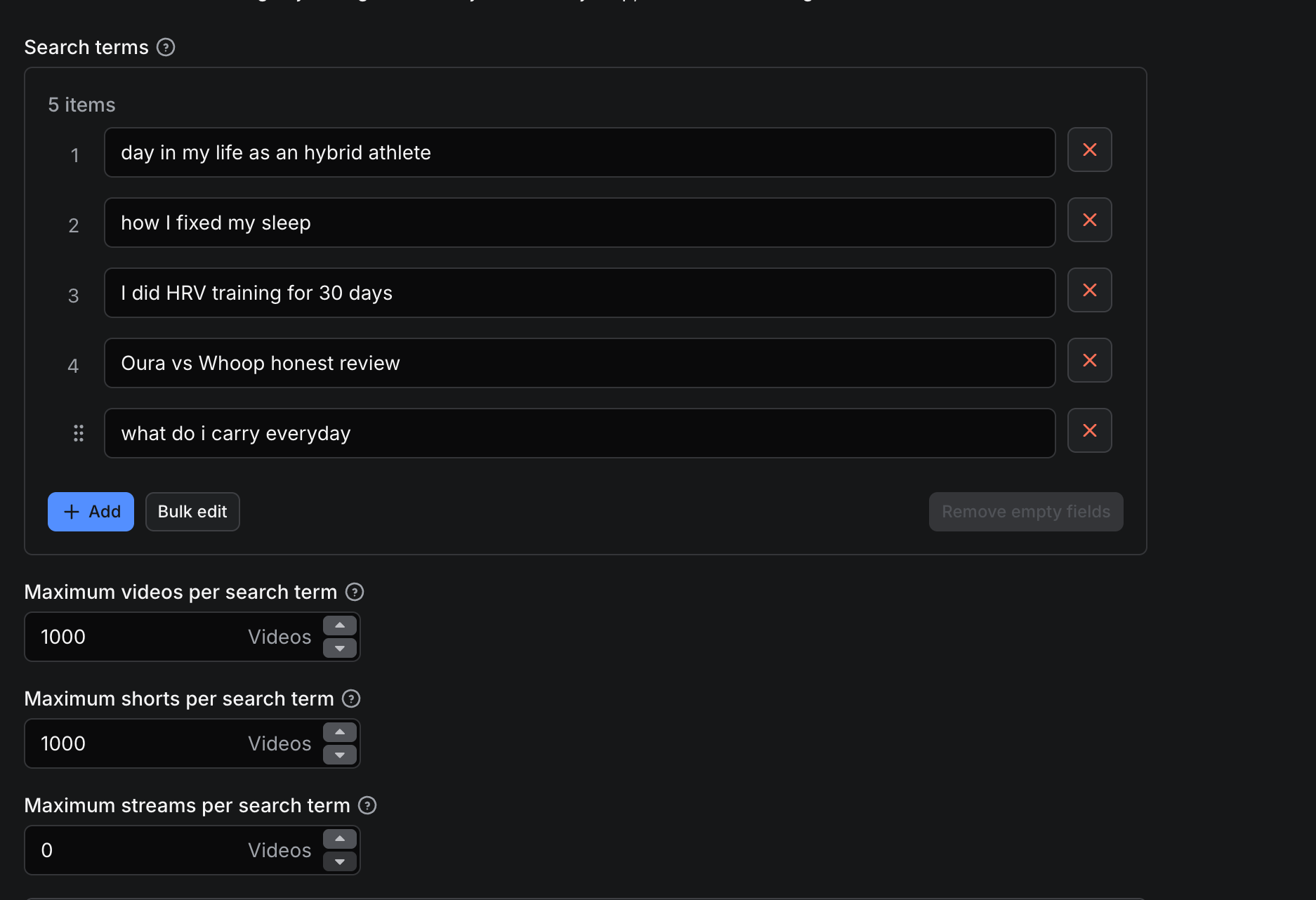 The entire Lane 3 input: five sentences your customer would type. Real YouTube Scraper config — up to 1,000 videos and 1,000 shorts per term.
That one config — five sentences — returns hundreds of channels per run for cents. Platform dialects differ: YouTube takes the full sentence, TikTok wants it shorter and trend-flavored ("edc dump," "cold plunge results"), Instagram runs on hashtags instead (#everydaycarry, #recoveryday, #wristcheck).
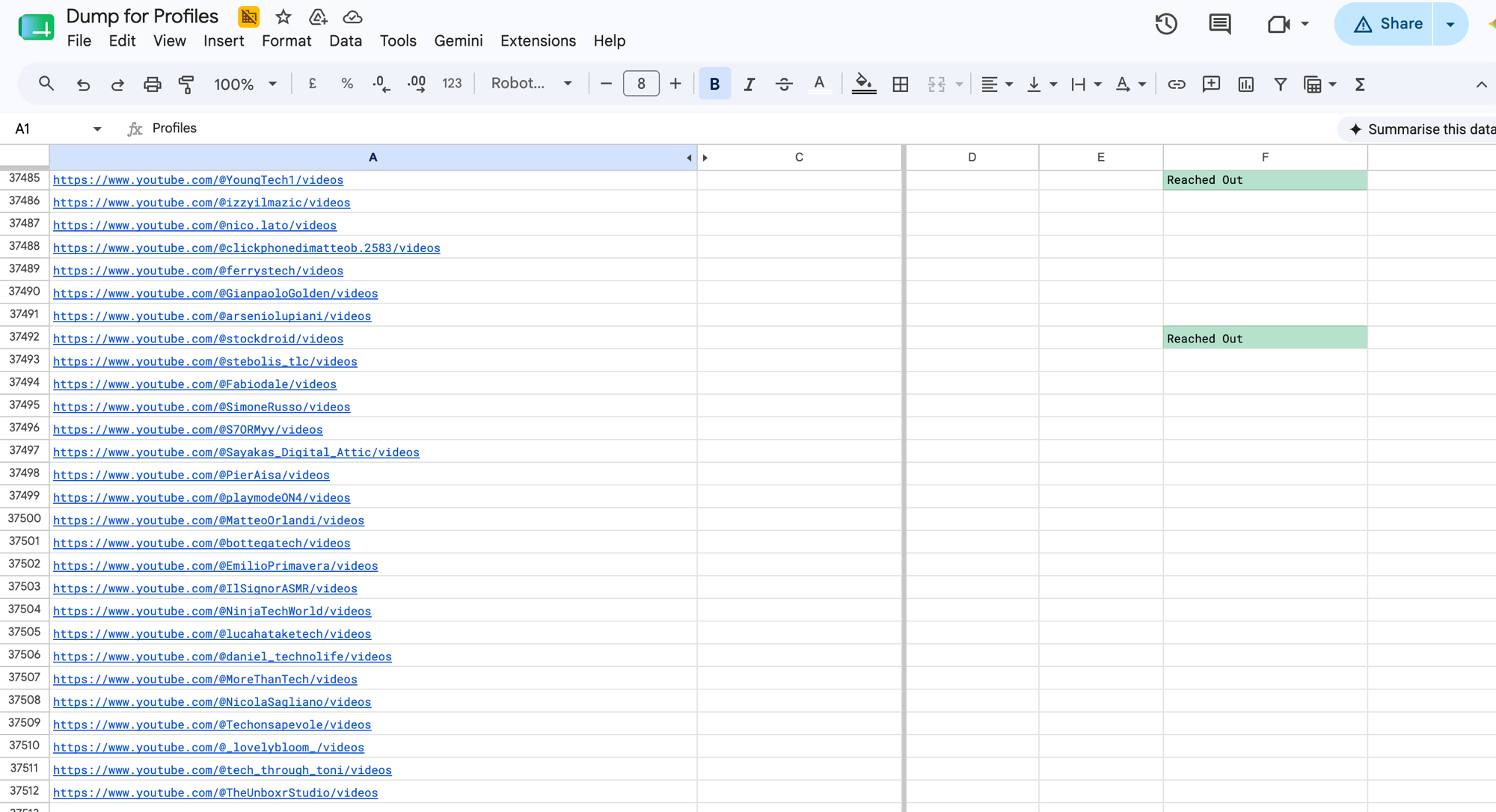 One tab of the raw dump: row 37,485 and counting. This is what a wide net looks like before scoring.
Set expectations correctly: this is the highest-volume lane and the dirtiest. The output includes dead channels, wrong niches, and agencies posing as creators. That's not a failure — that's what a wide net catches. We can afford to not care at this stage because every row gets scored by Sift before a human ever reads it; when cleanup costs nothing, dirty volume is pure upside. If you're vetting by hand, cap your scraper runs at what you can actually review — a wide net you can't filter is just a bigger backlog.
Run it today: pick your two strongest genres, write five queries per genre using the shapes above, put them into a scraper, cap it at 1,000 results per term, point the output at your master sheet.
5. Lane 4 — Rent the enterprise database, skip the contract
The enterprise influencer platforms — Modash, Upfluence, and their tier — have genuinely good discovery databases. Follower range, engagement floor, country, genre, and the feature that matters most for this pipeline: lookalike search by handle. Their index sees accounts the platform UIs will never surface to you.
What they don't have is a reason to charge you $199-2,500 a month for it — unless you move in. So don't move in. The cheapest tier is a faucet: turn it on for one month, extract everything it will give you, and decide later whether it stays in the rhythm.
The protocol:
- Buy the cheapest tier. Entry plans in this category ran around $199/mo at last check — pricing moves, so verify. One month is the commitment, not a contract.
- Feed it your Lane 1 seeds. Run every seed through lookalike search. This is the same snowball as Lane 2, but running on their crawled index instead of the platforms' suggestion surfaces — it reaches accounts the free lanes structurally can't.
- Sweep the filter grid. Every genre × your follower range × your markets. Each combination is an export.
- Export to the daily cap, every day. The monthly allowance is the real product. Batch it like a job, because it is one.
Everything lands in the master sheet, tagged lane=modash.
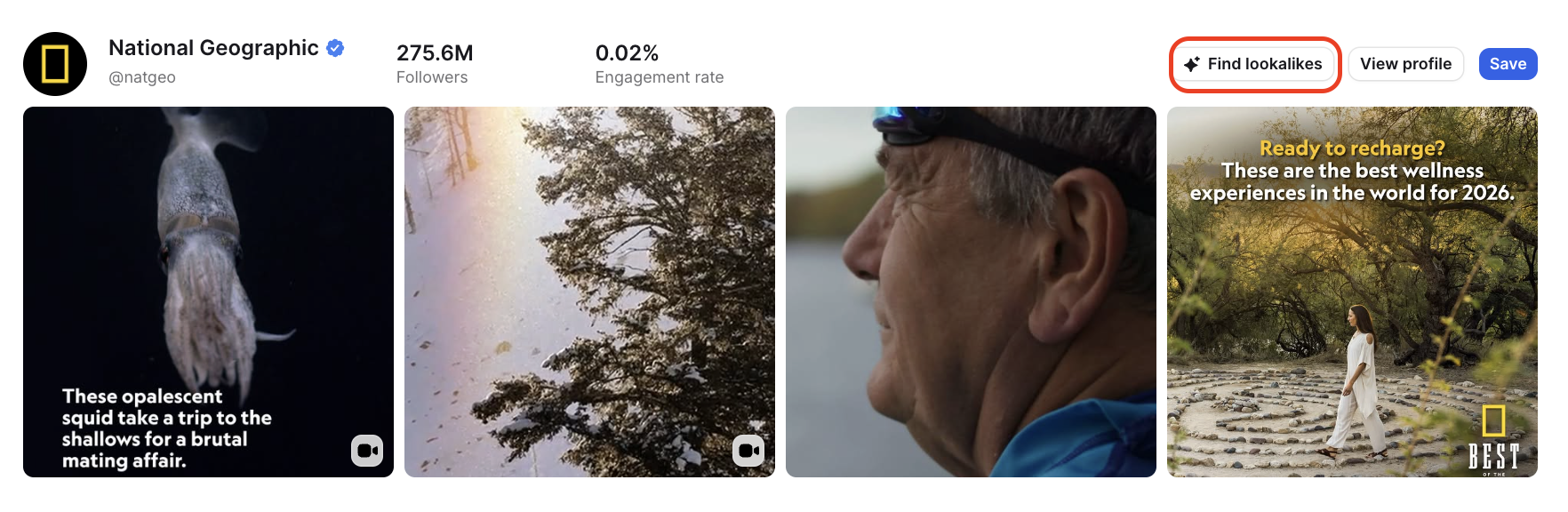 The lookalike entry point: any profile in Modash's index has a "Find lookalikes" button — this is the faucet. (Source: Modash help center.)
Set expectations here too: the list is big and it is unclean. Inflated engagement, dead accounts, wrong-market profiles — all present. There are also real creators in there you will not find any other way, and at the entry-tier price for thousands of rows, this is the cheapest volume per dollar of any paid lane. The export's dirtiness stopped being a cost the day we stopped reading it — the CSV goes into Sift, a ranked shortlist comes out, and the junk rows never touch anyone's attention. Done daily for a month, this lane builds a serious top of funnel.
One sentence on why this feels like a trick but isn't: you're paying for their database, which is excellent — you're just not paying for their workflow, which is the part that was never worth $2,500 a month.
Run it today: if you have seeds from Lane 1, start the cheapest-tier month now and put a 30-minute daily export slot on your calendar. No seeds yet? Run Lanes 1-2 for two weeks first — lookalike search without good seeds is just the generic database everyone else exports.
6. The merge: one sheet, one hand-off
Four lanes, one destination. Every row that any lane produces lands in the same sheet with the same columns:
handle | platform | genre | source lane (+ via @seed) | date | status
That's the whole schema. The discipline is boring and non-negotiable: no lane keeps its own file, no "I'll merge the CSVs later," no orphan exports. A lane that doesn't drain into the master sheet doesn't exist.
Two operational rules at the merge:
Dedupe by handle — but log the collision before you collapse it. When two lanes surface the same creator, that's not waste, it's confirmation. A profile that shows up in your Lane 2 snowball and the Lane 4 database export was found by two unrelated similarity engines. Track it in a lanes_hit count if you want the cheap version of a confidence score before any real scoring happens.
Keep the source columns forever. They're what turns the pipeline from a pile into a system: hit rates per lane and per seed tell you which faucets to open wider and which trees to stop harvesting. Without provenance, every sourcing decision next month is a guess again.
And here is where sourcing ends. Our sheet has 50,000+ rows, and every one of them looks exactly the same: a handle and a follower count. The sheet cannot tell you who's real, who's alive, who's contactable, whose audience is bought, or who has any history of actually posting when a brand ships them product. Those are different questions — vetting questions — and answering them by hand at this volume is a different order of work than collecting the rows was. This is the part we built Sift for: the master sheet goes in, those questions get answered per row, and outreach starts from a ranked shortlist instead of row 1 of 50,000.
If you want the vetting layer itself unpacked, that's its own post: how to vet creators before outreach. For the wider system this pipeline plugs into, see the high-volume seeding playbook and how Ultrahuman runs creator seeding.
The pipeline doesn't finish — that's the point of it. Lanes run, the sheet grows, seeds earn their keep or get cut. Nothing here was a system on day one. It's runs, compounding.